Idioms about art are phrases that borrow words from painting, drawing, and pictures to describe everyday life. “Blank canvas” means a fresh start with no limits. “Back to the drawing board” means starting over after a failure. This guide explains 25 of these phrases in plain English.
Each entry gives the meaning, a documented origin (where one exists), a natural example, and a tone tip. You will also find look alike comparisons and a list of common mistakes. A short quiz at the end tests what you learned.
Definition: An art idiom is a fixed phrase that uses words from painting, drawing, or pictures to express an idea beyond the literal words. Example: “After the layoffs, the team went back to the drawing board.”
Quick Answer: The Most Common Idioms About Art
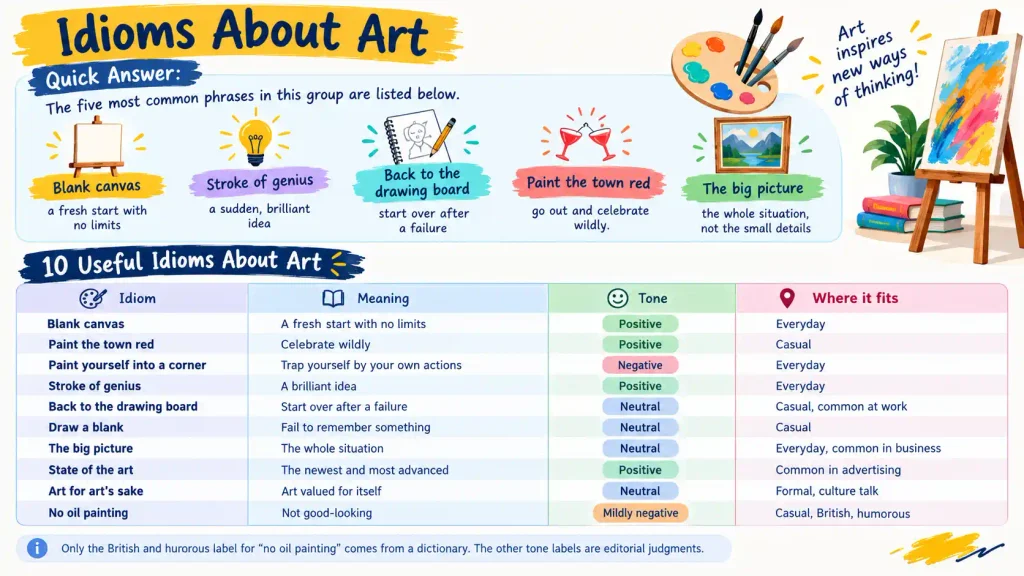
The five most common phrases in this group are listed below.
- Blank canvas: a fresh start with no limits
- Stroke of genius: a sudden, brilliant idea
- Back to the drawing board: start over after a failure
- Paint the town red: go out and celebrate wildly.
- The big picture: the whole situation, not the small details
The table below adds tone and usage for ten of the most useful phrases.
| Idiom | Meaning | Tone | Where it fits |
| Blank canvas | A fresh start with no limits | Positive | Everyday |
| Paint the town red | Celebrate wildly | Positive | Casual |
| Paint yourself into a corner | Trap yourself by your own actions | Negative | Everyday |
| Stroke of genius | A brilliant idea | Positive | Everyday |
| Back to the drawing board | Start over after a failure | Neutral | Casual, common at work |
| Draw a blank | Fail to remember something | Neutral | Casual |
| The big picture | The whole situation | Neutral | Everyday, common in business |
| State of the art | The newest and most advanced | Positive | Common in advertising |
| Art for art’s sake | Art valued for itself | Neutral | Formal, culture talk |
| No oil painting | Not good-looking | Mildly negative | Casual, British, humorous |
Only the British and humorous label for “no oil painting” comes from a dictionary. The other tone labels are editorial judgments.
Idioms About Art With “Art” in the Phrase: Meaning and Origin
Seven idioms use the word art itself, and several have a documented history.
Art for art’s sake. This means art has value on its own, even if it teaches nothing and sells nothing. Example: “My teacher said to paint for art’s sake, not for grades.” According to Etymonline, the phrase entered English in 1824 as a translation of the French l’art pour l’art. Who said it first is disputed. Names often tied to it include Victor Cousin, Benjamin Constant, Théophile Gautier, and Edgar Allan Poe. No single inventor is settled, so treat any one name with care.
Art is long, life is short (ars longa, vita brevis). This means mastering a craft takes more time than one life offers. Example: “I’ve played piano for thirty years and still learn something new. Ars longa, vita brevis.” The line goes back to the Greek physician Hippocrates, who opens his Aphorisms with it. The Greek word behind “art” is technē, which means craft or skill. He was talking about medicine, not paintings. English speakers usually quote the Latin version. A common reading is “great art outlives the artist.” That fits the modern English word, but it is not what Hippocrates meant.
Life imitates art. This means real life copies what artists and writers imagine first. Example: “After that TV show, everyone started using the same slang. Life imitates art.” Oscar Wilde wrote the idea in his essay “The Decay of Lying,” first printed in 1889 and collected in his 1891 book Intentions. His wording was stronger: life imitates art far more than art imitates life.
State of the art. This means the newest, most advanced version of something. Example: “The school opened a state of the art science lab.” The earliest recorded use appears in a 1910 book on gas turbines by Suplee. So the phrase first showed up in engineering writing, not in galleries. Today it turns up mostly in ads and product pages, and Grammarist calls it an overused advertising phrase.
Down to a fine art and a work of art. “Down to a fine art” describes a skill done so well it looks easy. “A work of art” praises something made with great care. Examples: “My mother has packing the car down to a fine art.” / “Look at this cake. It’s a work of art.” The Oxford Dictionary of English Idioms dates “fine art” itself to the first half of the 1800s. No separate documented origin turns up for either full phrase.
Artistic license. This means the freedom to bend facts or rules so a creative work turns out better. Example: “The movie moved the battle to night. The director called it artistic license.” The tone depends on who is speaking.
Painting Idioms About Art: Fresh Starts, Big Ideas and Risky Choices
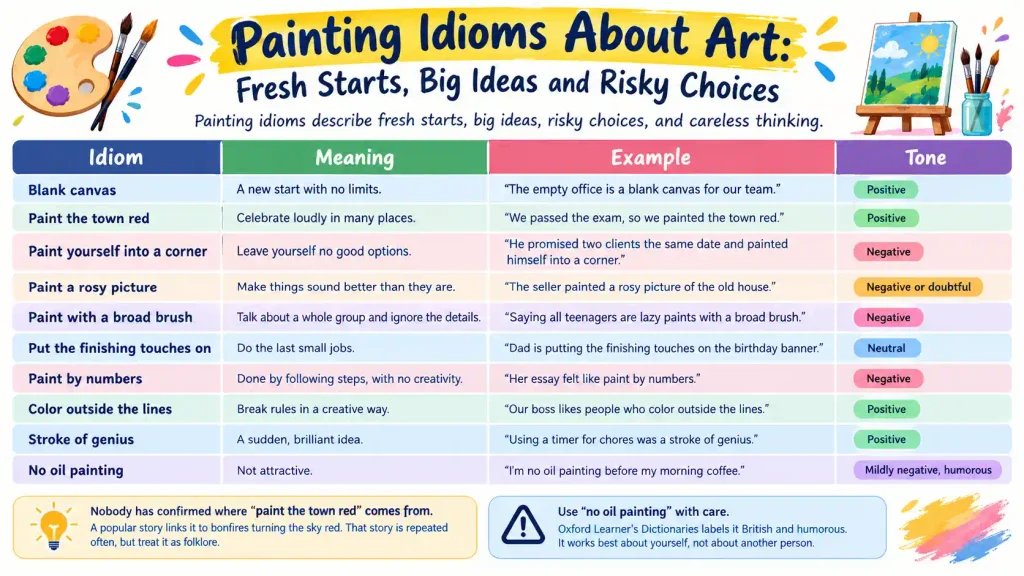
Painting idioms describe fresh starts, big ideas, risky choices, and careless thinking.
| Idiom | Meaning | Example | Tone |
| Blank canvas | A new start with no limits | “The empty office is a blank canvas for our team.” | Positive |
| Paint the town red | Celebrate loudly in many places | “We passed the exam, so we painted the town red.” | Positive |
| Paint yourself into a corner | Leave yourself no good options | “He promised two clients the same date and painted himself into a corner.” | Negative |
| Paint a rosy picture | Make things sound better than they are | “The seller painted a rosy picture of the old house.” | Negative or doubtful |
| Paint with a broad brush | Talk about a whole group and ignore the details | “Saying all teenagers are lazy paints with a broad brush.” | Negative |
| Put the finishing touches on | Do the last small jobs | “Dad is putting the finishing touches on the birthday banner.” | Neutral |
| Paint by numbers | Done by following steps, with no creativity | “Her essay felt like paint by numbers.” | Negative |
| Color outside the lines | Break rules in a creative way | “Our boss likes people who color outside the lines.” | Positive |
| Stroke of genius | A sudden, brilliant idea | “Using a timer for chores was a stroke of genius.” | Positive |
| No oil painting | Not attractive | “I’m no oil painting before my morning coffee.” | Mildly negative, humorous |
Nobody has confirmed where “paint the town red” comes from. A popular story links it to bonfires turning the sky red. That story is repeated often, but treat it as folklore.
Use “no oil painting” with care. Oxford Learner’s Dictionaries labels it British and humorous. It works best about yourself, not about another person.
Drawing and Sketching Idioms About Art: Memory, Restarts and Limits
Drawing idioms describe memory lapses, restarts, limits, and vague plans.
| Idiom | Meaning | Example |
| Draw a blank | Fail to remember something | “I drew a blank when the teacher asked for the date.” |
| Back to the drawing board | Start the plan over after it fails | “The test failed, so it’s back to the drawing board.” |
| Draw the line | Set a limit on what you accept | “I’ll help with your move, but I draw the line at carrying the piano.” |
| Sketchy | Lacking detail, or a little suspicious | “His story sounded sketchy, so we asked for proof.” |
“Sketchy” has two senses. In a work report, it means “missing details.” In casual chat, it often means “shady.” Context shows which one the speaker has in mind.
Picture Idioms About Art: A Thousand Words and the Big Picture
The modern wording of “a picture is worth a thousand words” traces to American advertising in the early 1900s.
Origin box:
- 1911: Newspaper editor Arthur Brisbane told an audience of advertisers to use a picture because it was worth a thousand words.
- 1921: Advertising man Fred R. Barnard ran a streetcar ad that said: “one look is worth a thousand words.”
- 1927: Barnard’s ad changed it to “one picture is worth ten thousand words” and called it a Chinese proverb.
No Chinese source for that proverb has been found. Stories that Confucius or Napoleon said it have no solid proof behind them.
Meaning: An image can explain what would take pages to describe. Example: “Don’t write a long email about the crack. Send a photo.”
Three nearby phrases get short entries:
- The big picture refers to the whole situation. “Forget the small errors and look at the big picture.”
- Picture perfect describes something flawless. “The wedding was picture perfect.”
- Get the picture means to understand. “No more details needed. I get the picture.”
Look-Alike Idioms About Art Compared
Several art idioms sound close but fit different situations.
Blank canvas vs clean slate vs fresh start
| Idiom | Use it when | Example |
| Blank canvas | You can create anything and nothing is in the way | “The new garden is a blank canvas.” |
| Clean slate | Past mistakes no longer count against you | “After paying the fine, she had a clean slate.” |
| Fresh start | You begin a new chapter | “Moving cities gave him a fresh start.” |
Blank canvas stresses creative freedom. Clean slate stresses erased history. Fresh start is the broadest of the three.
Common Mistakes With Idioms About Art and How to Fix Them
Most errors come from spelling, hyphens, and reversed word order.
Canvas vs canvass
- Wrong: “The volunteers will canvas the neighborhood.”
- Right: “The volunteers will canvass the neighborhood.”
Canvas is a noun. It means a strong cloth, or the surface a painter uses. Canvass is mostly a verb that means to survey people or ask for votes. To remember the difference, think of the extra s as standing for “survey.”
State of the art vs state of the art
- Right (noun phrase): “This lab is the state of the art.”
- Right (adjective before a noun): “This is a state-of-the-art lab.”
Add hyphens when the phrase sits before a noun. Leave them out when it stands alone.
Which way round? Life imitates art vs art imitates life.
Wilde’s line says life imitates art. “Art imitates life” is the older, opposite idea: artists copy the world around them. Both are fine to say. The error is crediting Wilde with the second one.
Quick Quiz on Idioms About Art: Test Your Memory
These six questions show how much you remember.
- Your mind goes empty during a speech. Which idiom fits?
- Who wrote that life imitates art far more than art imitates life?
- Choose the right word: “The students will (canvas/canvass) the school for donations.”
- Choose the right form: “She bought a (state of the art/state-of-the-art) camera.”
- In Hippocrates’ famous line, what did the Greek word technē refer to?
- Which idiom is a mild, humorous way to say someone isn’t good-looking?
Answer key: 1. Draw a blank. 2. Oscar Wilde. 3. Canvass, because it’s the verb. 4. State-of-the-art, because it comes before the noun camera. 5. Craft or skill. 6. No oil painting.
Frequently Asked Questions About Idioms About Art
These three questions cover what learners ask most.
What are some common idioms about art in English?
Common examples include blank canvas, stroke of genius, back to the drawing board, paint the town red, and the big picture. Each one takes a word from painting or drawing and applies it to daily life. See the quick answer table for meanings and tone.
What does it mean to have a blank canvas?
Having a blank canvas means starting with no limits and plenty of room to create. It carries a positive tone. Example: “The empty apartment is a blank canvas, so we can decorate any way we like.”
Where does “a picture is worth a thousand words” come from?
The modern wording comes from American advertising in the 1910s and 1920s. Arthur Brisbane used a version in 1911. Fred R. Barnard’s ads followed in 1921 and 1927, and the “Chinese proverb” label first appears in the 1927 ad.
Conclusion: Why Idioms About Art Are Worth Learning
Art idioms turn paint, pencils, and pictures into short ways to talk about fresh starts, big ideas, and bad choices. Learn the common ones first: blank canvas, stroke of genius, and back to the drawing board. Then add the phrases with real history, such as “art for art’s sake” and “life imitates art.” Match each phrase to the right tone, and watch for the spelling traps with canvas and canvass. Try the quiz again in a week to see what stayed with you.
To read more: Idioms for Trees: 11 Essential Phrases and Common Mistakes